
Denali Therapeutics’ recent accelerated approval of AVLAYAH, an enzyme replacement therapy for Hunter syndrome (MPS II), is a milestone accomplishment in blood brain barrier (BBB)-crossing technology. Despite the historical difficulty in designing therapeutics that cross the BBB, Denali’s landmark approval could signal an inflection point for the BBB-crossing therapeutic pipeline. Given recent interest from large pharma (e.g. Novartis’ $1.7B deal with SciNeuro including $165M upfront1, GSK’s $2.5B deal with ABL Bio including ~$100M in upfront / near-term payments and Roche’s $2B deal with Manifold Bio including $55M upfront) 2, we analyzed the active pipeline of BBB-crossing programs and the platforms behind them.
Among the most promising are receptor-mediated transcytosis (RMT)-crossing technologies targeting the Transferrin Receptor (TfR) with a number of biotechs developing antibody shuttle programs employing this approach. These include the Denali’s TransportVehicle platform which was leveraged for AVLAYAH, as well as other antibody shuttles such as JCR Pharmaceutical’s J-Brain Cargo, and BioArctic’s BrainTransporter.
However, there are other innovative programs outside of the TfR space: these include Evox Therapeutics’ exosome-based ExoEdit platform, as well as Voyager’s TRACER AAV capsid platform, which screens for capsids with high BBB-penetration; the latter has seen a few licensing deals in recent years, including a $100m upfront deal partnering with Novartis in 20243.
We looked at emerging technologies in the space and classified identified assets by what mechanism and/or delivery vehicle they crossed the BBB
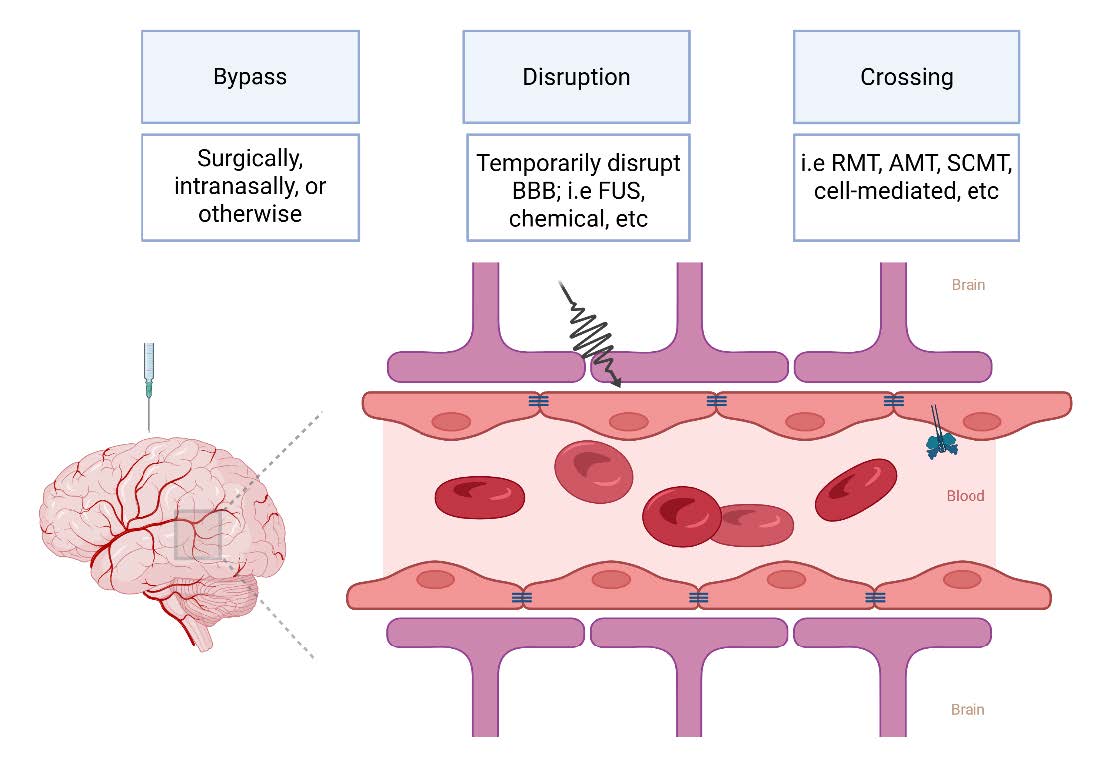
Generally, there are three approaches that enable therapeutic agents to bypass or cross the BBB for delivery into the brain. The BBB can be temporarily disrupted, using techniques such as ultrasound or laser therapy in order to allow for spatial and temporal control over therapeutic delivery into the brain at the disrupted location, the BBB can be crossed using endogenous mechanisms of transcytosis such as RMT, or the BBB can be bypassed entirely through direct delivery routes like intrathecal or cerebral injection. We analyzed emerging and novel technologies focused on the disruption or crossing of the BBB, excluding any small molecules that passively diffuse, or use surgical methods to bypass the BBB entirely4. Several platforms that were AI-driven to optimize therapeutic structure for passive diffusion were also thus not included.
Exhibit 1: Approaches to deliver therapeutics into the brain. Acronyms: RMT = receptor-mediated transcytosis, AMT = Adsorptive-mediated transcytosis, SCMT = solute carrier-mediated transcytosis (Created in https://BioRender.com)
Our analysis started with an initial dataset from PharmaProjects of ~5,500 active assets across neurology, neuro-oncology, and metabolic rare disease. Classification of assets was performed through a multi-LLM approach using a validated prompt with integrated web search, allowing the AI model to combine PharmaProjects data with publicly available information for each asset. Model development was iterative until manual validation demonstrated 95% accuracy. Each asset was first classified as BBB-specific or not, and where applicable, further classified by delivery mechanism and delivery vehicle. Once we obtained a final list of BBB-crossing / disrupting assets, we manually confirmed each classification.
After a deep review of the scientific literature5-9, we classified BBB-crossing therapeutics in development by the following delivery mechanisms to cross the BBB (Exhibit 2).
Exhibit 2: Classifications of BBB-crossing / disrupting assets
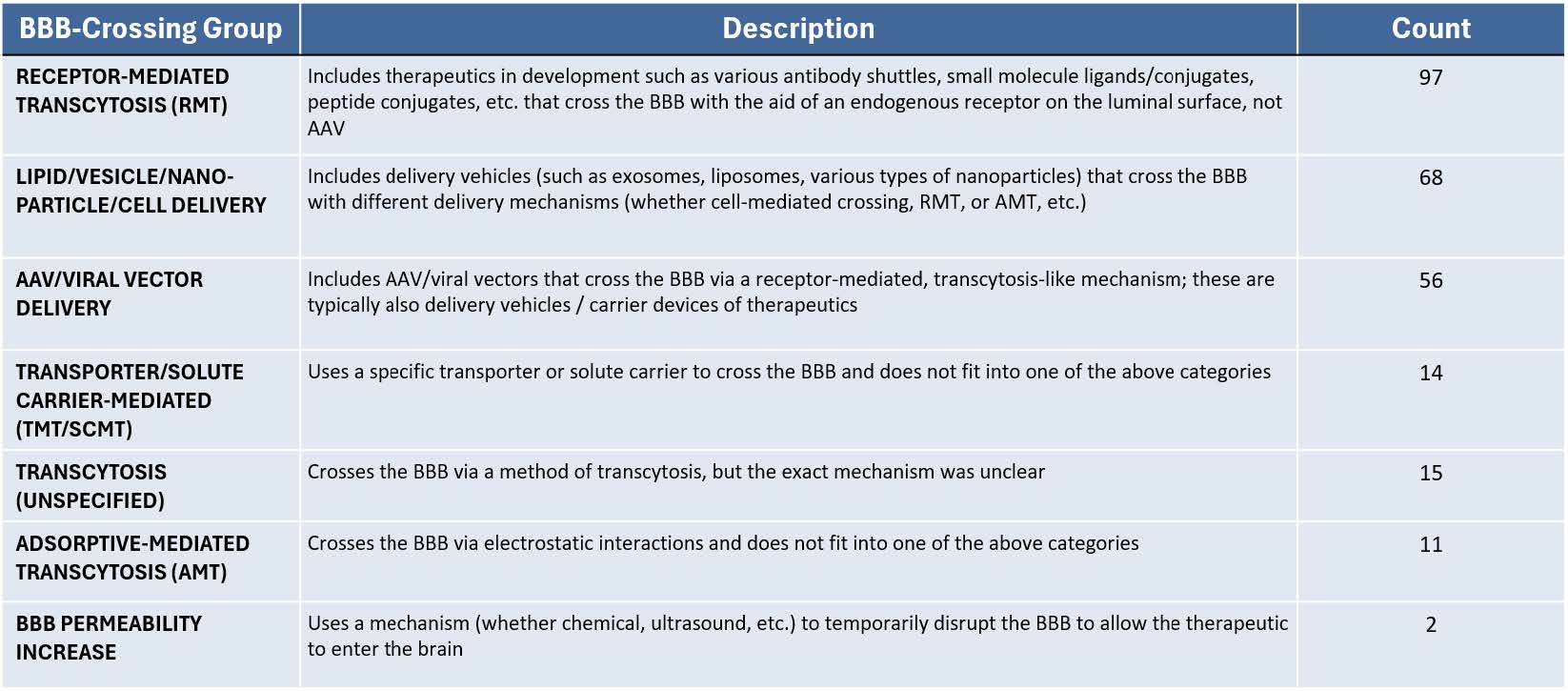
While there continues to be a focus on various methods of using RMT to target the TfR receptor – we found 62 out of 97 RMT assets in development targeting the TfR/TfR1 receptor (with a further 18 targeting an undisclosed receptor) – recent attention has also shifted to other methods. Out of the ~263 programs we found to be engineered to disrupt or cross the BBB, 37% were engineered to cross the BBB by RMT, 26% by the Lipid / Vesicle / Cell / NP category, and 21% by the Viral Vector category, with the others categorized as shown above.
We also examined the types of delivery vehicles and engineered assets in development within these broader categories (Exhibit 3). Perhaps unsurprising given Denali’s recent success, we found that various types of antibody (Ab) shuttles carrying therapeutics accounted alone for ~27% of the BBB-crossing drugs. These shuttles included bispecific and engineered Ab shuttles like JCR Pharma’s J-Brain Cargo, full length IgG like Alector’s ABC platform or BioArctic’s BrainTransporter, or engineered Fc / monovalent antibody fragments like Denali’s TransportVehicle, among others.
However, we also noted a meaningful push into novel capsids (e.g. Voyager’s TRACER program), exosomes (e.g. Evox Therapeutics’ ExoEdit platform), and various nanoparticles (i.e. Lauren Sciences’ V-Smart platform); collectively these accounted for another 46% of delivery approaches.
Exhibit 3: BBB-crossing assets by delivery vehicle / engineering
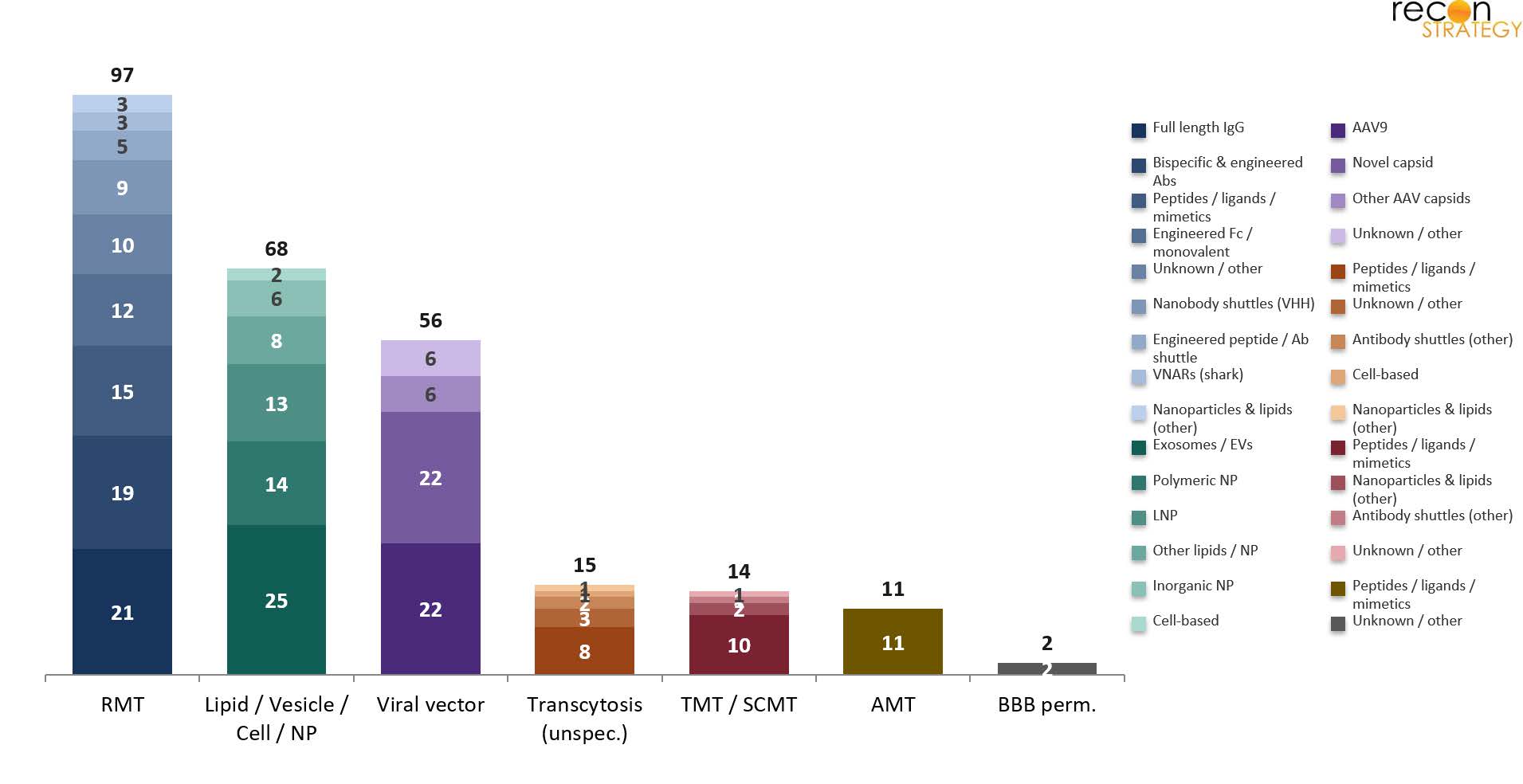
Analysis of emerging technologies shows antibody shuttles, viral vector capsids, and exosome- and nanoparticle-based BBB-crossing platforms emerging, with antibody shuttles seeing greatest investment by industry
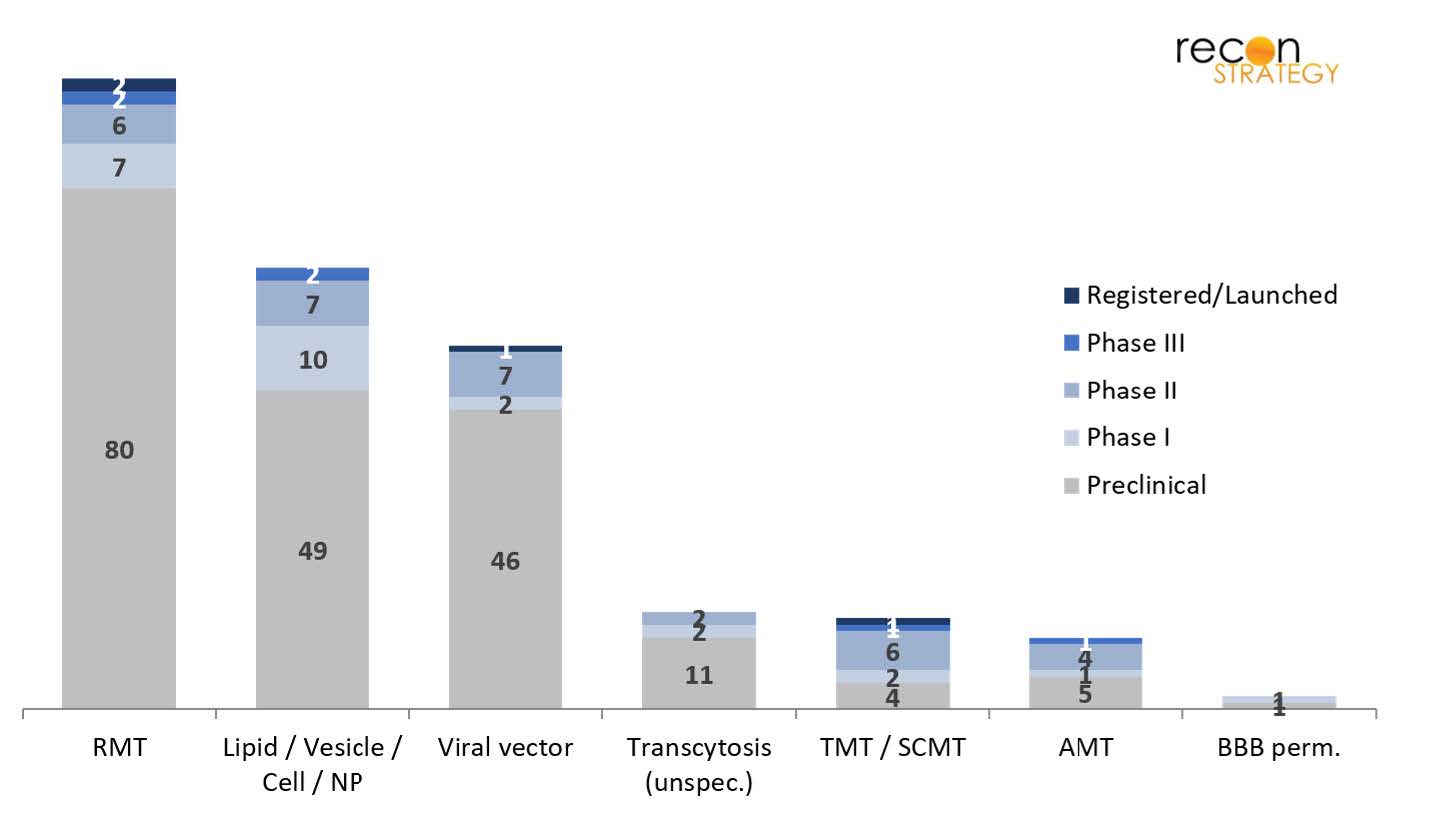
With roughly 25% of assets at clinical stage, the field is still actively testing which modalities cross the blood-brain barrier most effectively, and the majority remain in development. A few vehicle types are more clinically advanced but with fewer assets, such as transporter/solute carriers (n=14; 71% clinical) and AMT (n=11; 54% clinical). Across the other delivery mechanisms and vehicles, advancement is relatively even, both in the preclinical-to-clinical mix and in progression through clinical trials (Exhibit 4).
Exhibit 4: Number of assets in each BBB-crossing group by phase
However, despite this relatively even clinical advancement, biopharma investment into novel technologies skews in favor of RMT technologies; while RMT assets are 37% of total assets, they account for 54% of assets with licensing deals.
RMT based approaches, both antibody shuttles and other technologies, were found to have the greatest deal activity from large pharma companies, with 25% of assets having licensing or acquisition transactions. All other delivery vehicle groupings have seen 9-11% of assets tied to an industry deal, further demonstrating that RMT garners the greatest interest in terms of number of programs and deals.
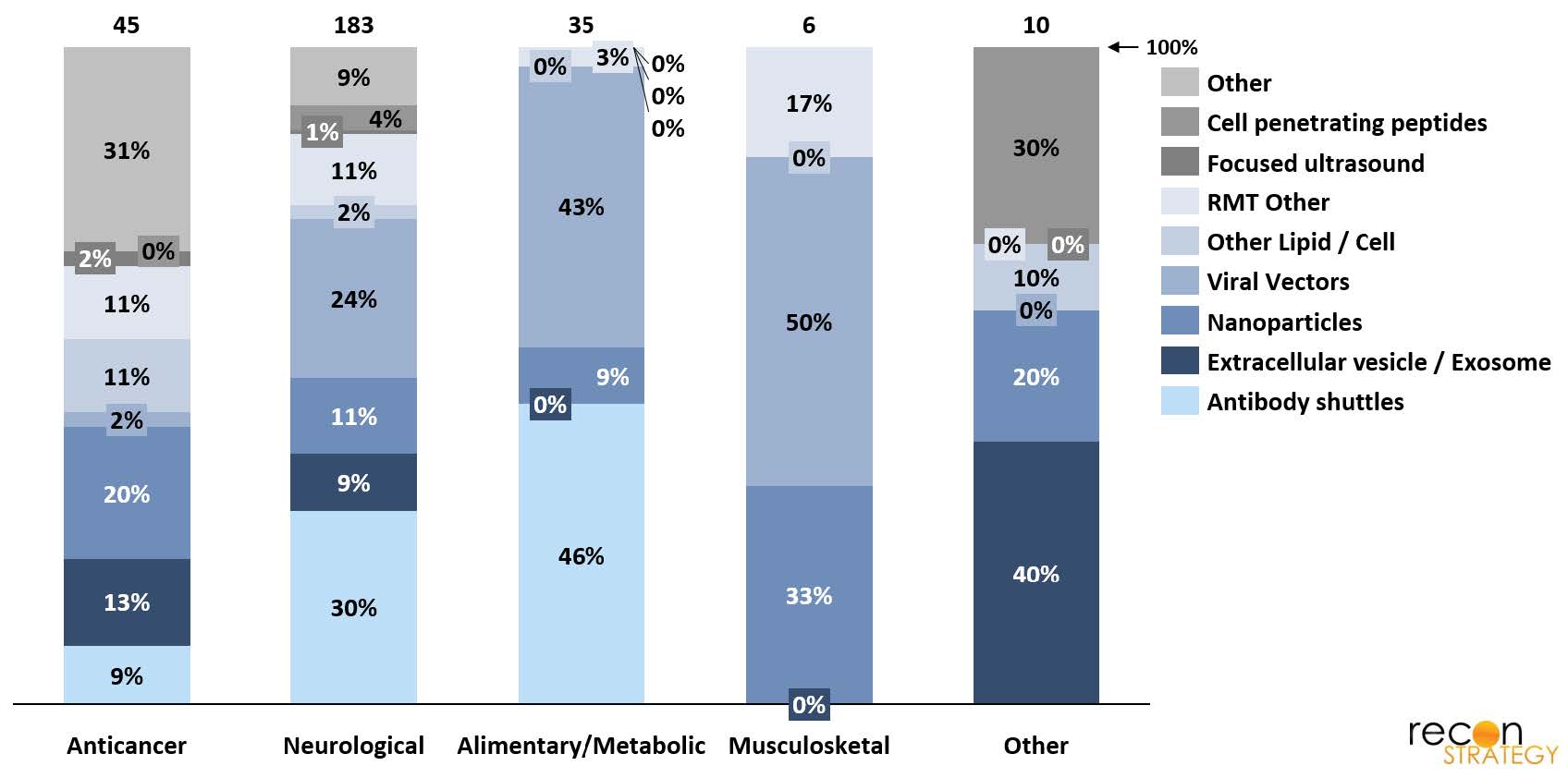
Looking at the TA focus of these BBB-crossing assets, as expected, the overwhelming majority have neurological indications. However, 46% of Engineered Fc / monovalent antibody shuttles and AAV9 also had an alimentary/metabolic indication listed, and 33% of the lipid nanoparticles had a neuro-oncological indication, showing a variety in targeted indications.
Furthermore, few antibody shuttles and viral vectors were targeting cancer TAs, which see a more diverse array of delivery vehicles into the brain (Exhibit 5).
Exhibit 5: Percent of delivery vehicles accounting for total assets having at least one indication in each TA
Conclusion
The BBB-crossing field appears to be shifting from its early concentration in RMT antibody shuttles toward broader platform diversification, with exosomes, nanoparticles, and novel capsids each gaining ground. Much of this shift is being pulled by the field’s move toward genetic and RNA-based medicines: antibody shuttles were built to carry protein cargo, whereas capsids, lipid nanoparticles, and exosomes are inherently suited to delivering the DNA and RNA payloads on which a growing share of CNS programs now depend. To date, however, RMT assets continue to account for a greater share of licensing activity, so while biotech has started to invest in newer modalities, RMT remains the approach most validated by industry. That distinction is beginning to blur, however. Capsid platforms such as Voyager’s TRACER have already drawn meaningful partnerships, and RMT shuttles are themselves being engineered to ferry the oligonucleotide payloads that increasingly define the newer categories.
In showing that a TfR-targeted shuttle can deliver a therapeutic across the BBB and secure regulatory approval, Denali has offered an early proof point for the broader space. The coming wave of readouts should test how far that promise extends: Denali’s confirmatory Phase III for AVLAYAH, efficacy data from Voyager’s programs, and initial results from Ionis’s VHH assets may begin to clarify which of the next generation of BBB-delivery technologies can translate scientific novelty into validated therapeutic and commercial success.
Endnotes
[1] SciNeuro. (n.d.). SciNeuro and Novartis enter into a licensing and collaboration agreement for next-generation therapeutics to treat Alzheimer’s disease. Retrieved from https://scineuro.com/scineuro-and-novartis-enter-into-a-licensing-and-collaboration-agreement-for-next-generation-therapeutics-to-treat-alzheimers-disease/
[2] ABL Bio. (n.d.). Company news. Retrieved from https://www.ablbio.com/en/company/news_view/837?keyword=&sort_desc=date
[3] Voyager Therapeutics. (2024). Voyager Therapeutics enters capsid license agreement and collaboration with Novartis [Press release]. Retrieved from https://ir.voyagertherapeutics.com/news-releases/news-release-details/voyager-therapeutics-enters-capsid-license-agreement-and/
[4] Katz, J. S., Slika, H., Sattari, S. A., Malla, A. P., Xia, Y., Antar, A., Ran, K., & Tyler, B. (2025). Overcoming the blood-brain barrier for drug delivery to the brain. ACS Omega, 10(30), 32544–32563. https://doi.org/10.1021/acsomega.5c00364
[5] Pedder, J., Sonabend, A., Cearns, M., et al. (2025). Crossing the blood–brain barrier: Emerging therapeutic strategies for neurological disease. The Lancet Neurology, 24, 246–260. https://doi.org/10.1016/S1474-4422(24)00476-9
[6] Piper, K., Kumar, J. I., Domino, J., Tuchek, C., & Vogelbaum, M. A. (2024). Consensus review on strategies to improve delivery across the blood-brain barrier including focused ultrasound. Neurooncology, 26(9), 1545–1556. https://doi.org/10.1093/neuonc/noae087
[7] Ding, L., Kshirsagar, P., Agrawal, P., & Murry, D. J. (2025). Crossing the blood-brain barrier: Innovations in receptor- and transporter-mediated transcytosis strategies. Pharmaceutics, 17(6), 706. https://doi.org/10.3390/pharmaceutics17060706
[8] Wu, D., Chen, Q., Chen, X., et al. (2023). The blood–brain barrier: Structure, regulation and drug delivery. Signal Transduction and Targeted Therapy, 8, 217. https://doi.org/10.1038/s41392-023-01481-w
[9] Wang, C., Wang, S., Xue, Y., et al. (2025). Intravenous administration of blood–brain barrier-crossing conjugates facilitate biomacromolecule transport into central nervous system. Nature Biotechnology, 43, 1783–1789. https://doi.org/10.1038/s41587-024-02487-7