
About the author: Chisom is currently a high school senior attending Boston Latin School. She spent the summer of 2025 with Recon Strategy as a paid intern assigned a project to research the effect of devices on sleep and well-being. Chisom plans to study ecology in college next year and is considering a career in wildlife biology.
Introduction
A New York Times article[1] published on April 29, 2025 talked about New York joining the list of states banning smartphones in schools. Schools argue that the rise of smartphones and social media has caused a significant number of students to face bullying and harassment online. Not only that, they also claim that it’s taking students’ attention away from the curriculum being taught. Society is quick to argue that digital devices negatively impact mental health, and while that may be true, I think there may be another factor that plays into the equation. Oftentimes my peers and I find ourselves comparing the number of hours of sleep we get on an average school night. While one can blame the heavy workload, it doesn’t stop people from playing sports or participating in extracurricular activities. The main culprit among the people I have talked to were devices, students instead of sleeping were scrolling through social media, or chatting and playing games with their friends, trying to get back the screen time they missed during the day.
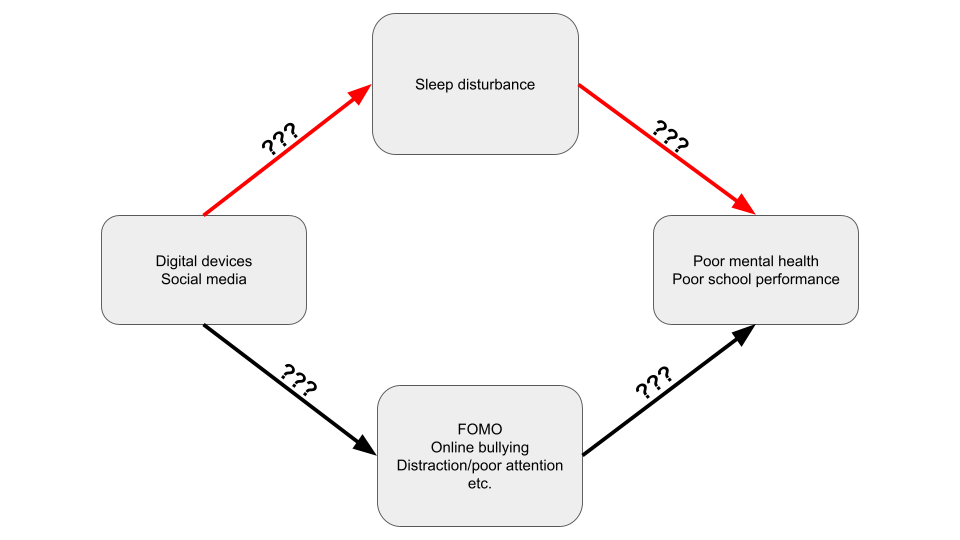
Exhibit 1
Exhibit 1 shows the connection between digital devices/social media and mental health/grades through two possible paths. One (bottom half of this graph) is the general consensus, as described in the New York Times article, and often the argument to limit in-school access to digital devices: that they promote feelings of anxiety (e.g., FOMO and online bullying), reduce attention span, and, as a result, worsen adolescents’ mental health and grades. An alternate hypothesis is that sleep could be a mediator between digital devices/social media and mental health/school performance; that is, the decline in mental health and grades could be the result of sleep issues: because instead of sleeping, kids are using their phones.
Approach
In order to come to a point of view on sleep as a potential cause of the negative effects of digital devices and social media on school performance and mental health, I proceeded in two steps:
- Reviewing how sleep affects mental function in US high school students in the absence of digital devices and social media.
- Reviewing how access to digital devices and social media affects sleep in US high school students
For each step, I selected two comprehensive review articles that aggregate all relevant studies and retained only those studies that apply to US high school students.
Step 1: relationship between US high school student sleep and functioning in the absence of digital devices and social media
For this analysis, I limited my research to studies from before the smartphone era (e.g., pre-2015) because it would be hard to find subjects in the present day who don’t use digital devices or social media, and they would be more akin to extreme outliers than the norm.
I used a review by Dewald et al. 2010[2], “The influence of sleep quality, sleep duration and sleepiness on school performance in children and adolescents: A meta-analytic review”. This paper includes 62 studies and has been cited 2,159 times per Google Scholar. I also used a review by Sochat et al. 2013[3], “Functional consequences of inadequate sleep in adolescents: A systematic review”. This paper includes 76 studies and has been cited 1,053 times.
Out of all studies cited in those two reviews, there were seven that matched the inclusion criteria (US, high school subjects).
Step 2: relationship between digital devices and sleep disturbances in US high school students
For this analysis, I used a review by Brautsch et al. 2022[4], “Digital media use and sleep in late adolescence and young adulthood: A systematic review”. This paper includes 42 studies and has been cited 150 times. I also used a review by Ahmed et al. 2024[5], “Social media use, mental health and sleep: A systematic review with meta-analyses”. This paper includes 98 studies and has been cited 53 times.
Out of all studies cited in those two reviews, there were five that matched the inclusion criteria (US, high school subjects).
Relationship between sleep and functioning in the absence of digital devices and social media
Table 1 presents the 7 studies that I identified in the reviews as focusing on the impact of sleep disturbances on US high school students before the widespread use of digital devices.
Table 1
| Study | Method | Findings | Comments |
| Sleep Scheduling and Daytime Functioning in Adolescents – Wolfson 1998[6] | Anonymous survey of 3,120 students in Rhode Island high schools | Those who went to bed 15-30 minutes later saw a decrease in their academic performance by 1-2 letter grades
A 90-minute change in total sleep time (TST) on school nights increases depression score on the Kendal Davis Scale by 1.31 |
Although there was a decrease in academic performance with later sleep schedules, that only applies to the lowest grade categories (C’s and D’s, D’s and F’s). The 15-30 minute time difference seems too small to explain the effect. |
| Functioning of Adolescents with symptoms of disturbed sleep – Roberts 2001[7] | A school-based survey of 5,423 Houston students | Compared to normal sleep, insomnia makes you 3 times more likely to report a mood disturbance | Most participants were upper elementary/middle school students, with roughly 30% being highschoolers |
| Impact of Insomnia on future functioning of adolescents – Roberts 2002[8] | Two surveys of students from the Houston area (N=4175 in wave 1, N=3134 in wave 2 follow-up)
|
High insomnia predicts new onset of depression a year later with an odds ratio of 3.58
|
The article doesn’t explain the differences between low, moderate, and high insomnia |
| Sleep and Risk Taking Behavior in Adolescents – O’Brien 2005[9] | A survey of 388 high school students in the Philadelphia area | A statistically significant relation between sleep and depression for a >90 min reduction in total sleep time
No significant relationship between grades and total sleep time |
Main focus of paper was risky behavior (drugs, alcohol, tobacco, sexual activity) |
| The Association of Insomnia with Anxiety and Depression – Johnson 2006[10] | A survey of 1676 students from the Detroit area | Insomnia predicts new depression with a hazard ratio of 3.8 | Clarifies that insomnia comes first then depression rather than the other way around |
| Sleepless in Adolescence: Prospective Data on Sleep Deprivation, Health, and Functioning – Roberts 2009[11] | Two surveys of students from Houston area (N=4175 in wave 1, N=3134 in wave 2 follow-up) | Short sleep (=< 6 hours) on weeknights and weekends predicts depression with a hazard ratio of 1.41
Short sleep on weeknights and weekends predicts poor grades with a hazard ratio of 2.1, short sleep on weeknights only predicts poor grades with a hazard ratio of 1.58 |
This study uses the same data as in reference [8] but focuses on sleep time rather than insomnia. |
| Depression and Insomnia Among Adolescents: A Prospective Perspective – Roberts 2012[12] | A survey of 4,175 students (3,134 would be surveyed in both waves) in the Houston metropolitan area | Symptoms of insomnia at baseline increased risk of major depression in wave 2. Major depression only increased risk for P2 (insomnia and daytime fatigue/sleepiness) | This study uses the same data as in reference [8] and has similar findings. |
Initially, I wasn’t expecting to find much data in the pre-smartphone era literature because I thought that lack of sleep was a more modern issue with the introduction of digital devices. It was a pleasant surprise to see that it was a topic heavily researched with a focus that went beyond lack of sleep but also included insomnia (insomnia in these studies was measured with the DSM-IV scale, classified as difficulty falling and staying asleep and receiving non restorative sleep independent of other sleep disorders, mental disorders, and substance use). Despite the research being scattered across a broad range of sleep characteristics and outcomes, I was able to come to some conclusions.
There was only a weak connection between sleep and grades. Among the studies there was varying data on this connection, with two studies directly contradicting each other (Wolfson et al. 1998 [6] and O’Brien et al. 2005 [9]). However, there was a stronger correlation between sleep and depression with all of the studies finding some connection between poor sleep and higher odds of depression.
Relationship between digital devices and sleep disturbances in US high school students
Table 2 presents the 5 studies that I identified in the reviews as focusing on the impact of digital devices on sleep in US high school students.
Table 2
| Study | Method | Findings | Comments |
| Adolescent Sleep and the Impact of Technology Use Before Sleep on Daytime Function – Johansson 2016[13] | 2011 Sleep in America poll, subsample of 255 adolescents with 140 ages 13-17 and 118 ages 18-21 | Individuals reporting “inadequate” sleep were significantly more likely than those reporting “adequate” sleep to text, use the internet and social media, and use a word processor before bed (p<0.05). | No details are provided regarding the level of technology use leading to inadequate sleep. |
| Decreases in self-reported sleep duration among U.S. adolescents 2009-2015 and association with new media screen time – Twenge 2017[14] | Monitoring the Future survey (75,784 students between 2009-2015) | Electronic device use (more than 3hr a day) increases the odds of getting less than 7 hr of sleep by 1.52, while social media use increases the odds by 1.31 | Uniquely this study shows how insufficient sleep rose between 2009 and 2015 coinciding with the introduction of technology. |
| Bedtime Autonomy and Cellphone Use Influence Sleep Duration in Adolescents – Tashjian 2018[15] | Survey of 98 students between the ages of 14-18 | Cellphone usage plays a role in total sleep duration, but not nearly as significant as students being told by their parents to go to bed | The sample size for the study was small |
| The association between excessive screen-time and insufficient sleep among adolescents: Findings from the 2017 youth risk behavior surveillance system – Baiden 2019[16] | 2017 school based national YRBS study (14,765 total respondents, 14,603 were 14-18 years old) | Controlling for all other factors, adolescents who
engaged in excessive screen-time behaviors (≥3 hours/day) were 1.34 times more likely to have insufficient sleep (< 8 hours) when compared to their counterparts who do not engage in excessive screen-time behaviors |
The study specified what type of screen time and excluded screen time that was used for academic purposes. |
| Associations of Social Media Use with Physical Activity and Sleep
Adequacy Among Adolescents: Cross-Sectional Survey – Shimoga 2019[17] |
Monitoring the Future annual cross-sectional survey of 8th, 10th and 12th graders (43,994 students) | No correlation between social media use and sleep. | The categorization of social media use only offered weekly vs daily responses and did not specify the hours spent on social media
|
Going through the studies exploring the effect of digital devices on sleep, I had expected to find more data than what I had found on the effects of sleep on student functioning, so I was surprised to find out that it wasn’t researched as extensively.
Most of the studies showed a negative correlation between device usage and sleep, with most of the studies supporting the idea that screen time decreases the amount of sleep that one gets. One of the studies (Twenge et al. 2017 [14]) states that electronic use of more than 3 hours a day substantially increases the odds of getting less than 7 hours of sleep. The overall finding among all the studies was that those who frequently used devices are more likely to report sleep issues.
However, there were problems with these studies as well. For example, one of the studies (Tashjian et al. 2018 [15]) had a sample size of 98 subjects. A sample size that small doesn’t give an accurate representation of the average teenager, especially since some of the subjects in this study were told when they should go to bed. Another study (Shimoga et al. 2019 [17]) had too broad of a categorization for social media use frequency, classifying subjects between using social media a few times a year, 1-2 times a month, once a week, and every day. It was also never specified how long the subjects were spending on social media, which could explain why they found no correlation between social media use and sleep.
Discussion
The review of relevant studies uncovered three main findings:
- There is limited evidence for a strong link between lack of sleep and school performance; not many studies focused on the connection between lack of sleep and school performance, and the two that did contradict one another. The paper that made the argument that lack of sleep affects academic performance (Wolfson et al. 1998 [6]) had a time frame too narrow for there to be any actual effects, and the drop in grades was more noticeable in those who were already performing poorly
- There is stronger evidence for correlation between sleep disturbances and depression, including causation — that is, that lack of sleep and insomnia are followed by depressive symptoms rather than the other way around (Johnson et al. 2006 [10])
- Likewise, there is good evidence that excessive use of digital devices and social media is linked to lack of sleep and that this is common in high-school students since the advent of new technology (Twenge et al. 2017, Baiden et al. 2019 [14,16]).
However, these studies often lack consistency and sometimes rigor in the way they measure sleep, depression, grades, and technology use:
- For sleep, measurement tools included: Epworth Sleepiness Scale, many custom Likert scales for quality of sleep, YRBS survey question “On an average school night, how many hours of sleep do you get”, MTF survey question “How often do you get at least seven hours of sleep?”, Total Sleep Time (TST) questionnaires, insomnia scales (L, M, H and P1, P2, P3), the Sleep Habit Survey (SHS), the Sleep–Wake Behavior Problems scale
- For depression, measurement tools included: the module on major depressive episodes from the Diagnostic Interview Schedule for Children (DISC-IV), DSM Scale for Depression (DSD), The Depressive Mood scale (Kandel & Davies), the Rosenberg Self-Esteem Scale
- For school performance, measurement tools included: crude grade scales and questionnaires “Mostly A’s and Bs, mostly Bs and Cs, etc.”
- For digital device and social media use, measurement tools included: custom use Likert scales (different between studies), hours on digital device for non-school work
Conclusion and a proposal
The overall conclusion of this analysis is that, though negative effects of digital devices and social media may be impacted by disturbed sleep, the evidence is weak because of study design. In particular, while the studies relate the total sleep time of adolescents to how much they were using their devices, they were never able to quantify how much sleep was lost due to their devices.
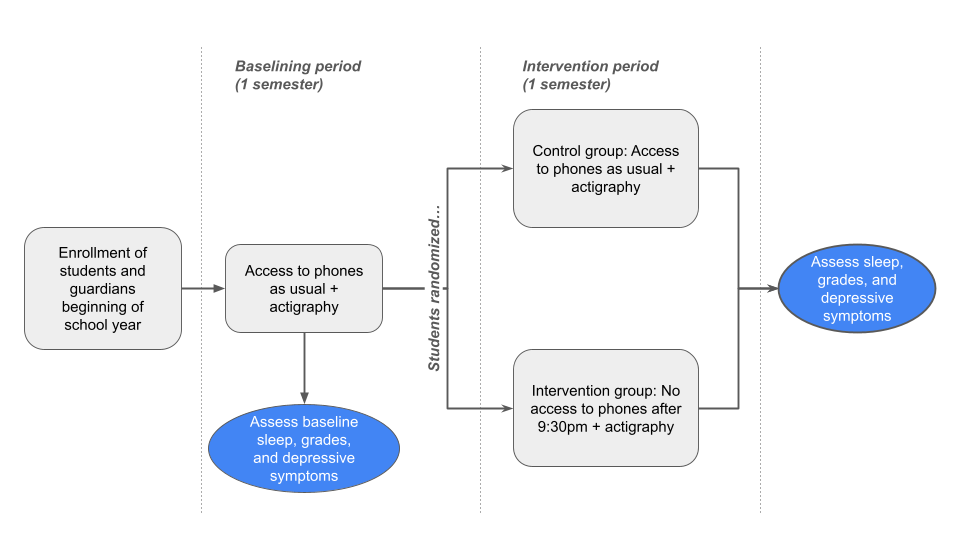
Exhibit 2
To quantify the effect of digital devices on sleep, I propose the following study. The subjects would be randomly split into two groups, the control group and the intervention group. The control group has access to their devices throughout the duration of the study (2 semesters), while the intervention group only has access for half the time. During the second semester, the intervention group won’t have access to their phones after 9:30 pm.
We would use actigraphy to measure sleep duration among both groups, and phone usage would be monitored in the intervention group to make sure that they aren’t using their phones when they’re not supposed to. After each semester, mental health and grades would be measured. Mental health would be measured through a survey while grades can be taken from their transcript. By the end of the study, we should have a clearer picture of how much sleep is lost from device usage. Then, using the data, we can compare it with differences in sleep duration and see how sleep can impact mental health and grades. Although most of my peers wouldn’t listen to this conclusion, especially if it means that they would have to break their nightly routine of scrolling through social media, the knowledge of how much sleep is lost with devices could significantly improve the mental wellbeing of high schoolers.
References
[1] Closson, Troy; New York Bans Smartphones in Schools, Joining National Movement, New York Times, April 29 2025
[2] Dewald, Julia F., et al. “The influence of sleep quality, sleep duration and sleepiness on school performance in children and adolescents: A meta-analytic review.” Sleep medicine reviews 14.3 (2010): 179-189.
[3] Shochat, Tamar, Mairav Cohen-Zion, and Orna Tzischinsky. “Functional consequences of inadequate sleep in adolescents: a systematic review.” Sleep medicine reviews 18.1 (2014): 75-87.
[4] Brautsch, Louise AS, et al. “Digital media use and sleep in late adolescence and young adulthood: A systematic review.” Sleep medicine reviews 68 (2023): 101742.
[5] Ahmed, Oli, et al. “Social media use, mental health and sleep: A systematic review with meta-analyses.” Journal of affective disorders 367 (2024): 701-712.
[6] Wolfson, Amy R., and Mary A. Carskadon. “Sleep schedules and daytime functioning in adolescents.” Child development 69.4 (1998): 875-887.
[7] Roberts, Robert E., Catherine R. Roberts, and Irene G. Chen. “Functioning adolescents with symptoms of disturbed sleep.” Journal of Youth and Adolescence 30.1 (2001): 1-18.
[8] Roberts, Robert E., Catherine Ramsay Roberts, and Irene Ger Chen. “Impact of insomnia on future functioning of adolescents.” Journal of psychosomatic research 53.1 (2002): 561-569.
[9] O’Brien, Erin M., and Jodi A. Mindell. “Sleep and risk-taking behavior in adolescents.” Behavioral sleep medicine 3.3 (2005): 113-133.
[10] Johnson, Eric O., Thomas Roth, and Naomi Breslau. “The association of insomnia with anxiety disorders and depression: exploration of the direction of risk.” Journal of psychiatric research 40.8 (2006): 700-708.
[11] Roberts, Robert E., Catherine Ramsay Roberts, and Hao T. Duong. “Sleepless in adolescence: prospective data on sleep deprivation, health and functioning.” Journal of adolescence 32.5 (2009): 1045-1057.
[12] Roberts, Robert E., and Hao T. Duong. “Depression and insomnia among adolescents: a prospective perspective.” Journal of affective disorders 148.1 (2013): 66-71.
[13] Johansson, Ann EE, Maria A. Petrisko, and Eileen R. Chasens. “Adolescent sleep and the impact of technology use before sleep on daytime function.” Journal of pediatric nursing 31.5 (2016): 498-504.
[14] Twenge, Jean M., Zlatan Krizan, and Garrett Hisler. “Decreases in self-reported sleep duration among US adolescents 2009–2015 and association with new media screen time.” Sleep medicine 39 (2017): 47-53.
[15] Tashjian, Sarah M., Jordan L. Mullins, and Adriana Galván. “Bedtime autonomy and cellphone use influence sleep duration in adolescents.” Journal of Adolescent Health 64.1 (2019): 124-130.
[16] Baiden, Philip, Savarra K. Tadeo, and Kersley E. Peters. “The association between excessive screen-time behaviors and insufficient sleep among adolescents: findings from the 2017 youth risk behavior surveillance system.” Psychiatry research 281 (2019): 112586.
[17] Shimoga, Sandhya V., Erlyana Erlyana, and Vida Rebello. “Associations of social media use with physical activity and sleep adequacy among adolescents: Cross-sectional survey.” Journal of medical Internet research 21.6 (2019): e14290.